MetaMask(前身为 Consensys Software Inc)是全球最大的自托管金融平台,为用户提供一站式服务,涵盖加密资产与传统资产的持有、消费、储蓄与增值。公司正在打造实现上述功能的消费级平台,将支付、储蓄、投资与数字资产整合于一体,带来无缝一体化的使用体验。MetaMask 脱胎于全球使用最广泛的自托管钱包,让用户直接掌控自己的资金与资产,覆盖约 190 个国家和地区。自 2016 年起,MetaMask 在以太坊的发展历程中扮演了举足轻重的奠基角色。如今,MetaMask 处于区块链经济的核心位置,致力于构建「开放货币」的操作系统,让每个人都能全面掌控自己的财务生活。
阅读所有文章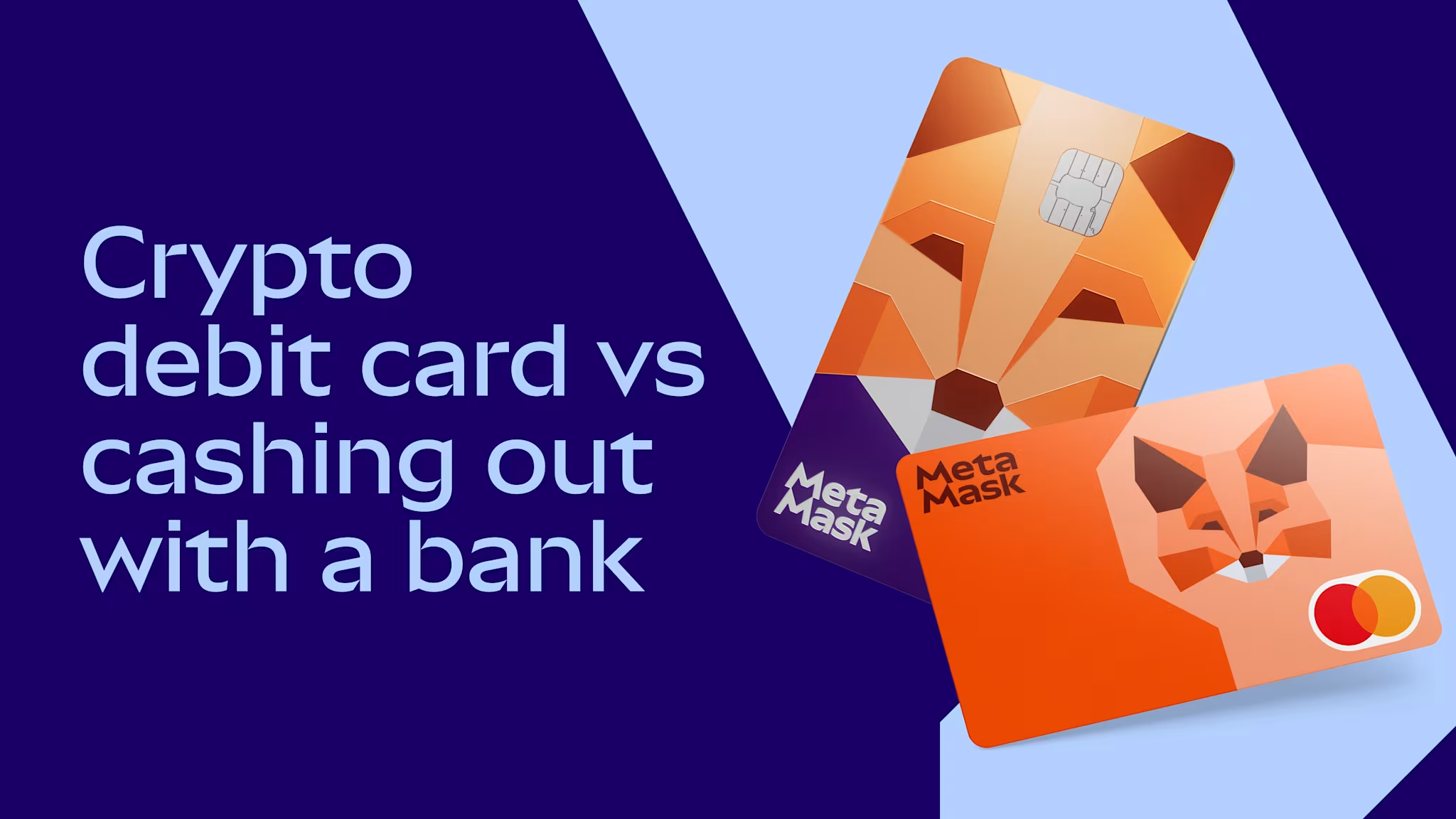
There are two common ways to use crypto for everyday spending: paying directly with a crypto debit card, or cashing out (offramping) crypto to a bank account or bank debit card. A crypto debit card converts digital assets to local currency at checkout. This guide compares both options by fees, speed, cashback, and tax.
Disclaimer: This content is for educational purposes only. It is not financial, tax, or legal advice, not a solicitation, and not for UK audiences. Fees, availability, and rewards change, and each provider's current terms apply.
Should I use a crypto debit card or cash out crypto to my bank?
When choosing between a crypto debit card and cashing out crypto via a bank, these are 4 common questions to ask:
Does the merchant or recipient accept card payments? Groceries, dining, and subscriptions can go on a crypto debit card, which pays straight from crypto at checkout. Rent, bank transfers, and money sent to people usually need a bank transfer.
How often is crypto spent? Daily or weekly purchases happen in one step at checkout with a crypto debit card, often with cashback. Cashing out before each payment means a sale, a withdrawal, and a wait before anything gets paid.
Which crypto is being spent? Stablecoins (crypto tokens pegged to a currency such as the US dollar) in the cardholder's home currency are often free to spend on a crypto debit card, while volatile tokens like ETH add a conversion fee on either route.
Is a crypto debit card available locally? Crypto debit cards launch region by region. Where one isn't available, cashing out to a bank is the only route, with fees and speeds set by the local bank network.
Expense | Crypto debit card | Spending from a bank account |
Groceries, dining, and subscriptions | Yes; converts at checkout and may earn cashback; paid in store or online | Yes; needs a cash out first, either before each purchase or as one larger transfer |
Spending abroad | Yes; cross-border fees vary by card tier and can be lower than a bank card's | Yes; foreign transaction or ATM fees often apply |
Rent, a mortgage, or a tax bill | Limited; works only if the payee accepts cards, often with a surcharge | Yes; sent by ACH, SEPA, wire, or direct debit |
Paying a person or business by bank transfer | Limited; works only if the payee takes card payments, through a checkout or payment link | Yes; reaches any bank account by ACH, SEPA, or wire |
Taking profit or reducing crypto holdings | No | Yes; one planned sale into local currency, on a centralized exchange or from a self-custodial wallet |
Large payments | Limited; capped by daily card limits | Yes; bank transfers allow larger amounts |
How much does a crypto debit card cost vs cashing out to a bank?
The examples in this guide use MetaMask: card figures come from MetaMask Card's published fees, and self-custodial wallet figures come from selling in MetaMask, where third-party providers such as Transak, MoonPay, Sardine, and Banxa quote and pay out the sale.
Cost | Crypto debit card | Selling from a self-custodial wallet | Selling on a centralized exchange |
Annual fee | $0 on the free Virtual tier; $199/year on the paid Metal tier, which adds higher cashback and limits | $0 | $0 |
Converting or selling crypto | $0 on a stablecoin in the cardholder's or merchant's currency; 0.5% on other stablecoins; 0.875% on other crypto, such as wETH (a token version of ETH); charged by the card issuer at checkout | Provider fee shown in the quote, including the wallet's 1% fee | Trading fee, spread (the gap between the quoted price and the market price), or both, shown before confirming; about 1% plus spread on simple buy and sell features |
Network fee | About $0.01 per purchase on Linea | Paid once to send the crypto to the provider; paid in ETH on Ethereum, or about $0.01 on low-fee networks like Linea | $0 if the crypto is already on the exchange; otherwise one network fee to move it there |
Bank payout | Not needed | $0 extra; the provider pays out by ACH in the US or SEPA in Europe as part of the sale | ACH (the standard US bank transfer network) is usually free; SEPA (the euro bank transfer network) is free or up to about €1 |
Instant payout to a bank debit card | Not needed | Available through some providers, depending on region | About 1.5% on Coinbase in the US, according to a 2026 Coin Bureau guide |
Foreign purchases | 1% cross-border fee on Virtual; $0 on Metal, subject to fair usage | Set by the bank; often 1%–3% on US bank debit cards; no extra fee on euro card payments within the EU under EU rules | Set by the bank; often 1%–3% on US bank debit cards; no extra fee on euro card payments within the EU under EU rules |
ATM cash | 2% on Virtual; free on Metal up to $1,200/month, then 2%; plus any ATM owner fee | Set by the bank; about $2.50–$3 outside the bank's network in the US; often free at the bank's own ATMs in the EU, or about €3–€5 at others | Same as the self-custodial route |
Limits | $15,000/day on Virtual; $30,000/day on Metal | Set by each provider and verification level; e.g., up to $20,000 per transaction with standard verification at Transak | Set by each exchange and verification level; e.g., up to $100,000 per instant bank cashout on Coinbase |
Sources: MetaMask Card limits and fees; How to sell crypto; Kraken cash withdrawal options; Coinbase Instant Cashouts; Coin Bureau, How to cash out on Coinbase; Upgrade Rewards Checking Preferred fees; EUR-Lex, Regulation 924/2009 on cross-border payments; Banco de España, ATM cash withdrawal fees; Monito, ATMs in Spain; Transak KYC Help Center; as of October 2026.
What does spending $100 of crypto a month cost with a crypto debit card vs cashing out?
This worked example shows the fees when an existing cardholder in the US spends $100 of USDC (a dollar-pegged stablecoin) a month at local merchants, either with a crypto debit card or by cashing out to a bank and paying with a bank debit card that earns no cashback. The figures are illustrative, use published fees as of October 2026, and assume the USDC is already on the exchange, or in the self-custodial wallet, with payouts sent by ACH.
$100 of USDC | Crypto debit card | Selling from a self-custodial wallet | Selling on a centralized exchange |
Paid with | Crypto debit card at checkout | Bank debit card, after an ACH payout | Bank debit card, after an ACH payout |
Annual fee | $0.00 (free Virtual tier) | $0.00 | $0.00 |
Converting or selling | $0.00; no conversion fee on USDC | $1.00+; provider fee, including the wallet's 1% fee | $0.00–$1.00+; 0%–0.20% on advanced trading, or about 1% plus spread on simple buy and sell features |
Network fee | About $0.01 per purchase on Linea | About $0.01; one transaction to send the USDC to the provider on Linea | $0.00; the USDC is already on the exchange |
Bank payout | $0.00; not needed | $0.00; included in the sale | $0.00; free by ACH |
Cashback | +$1.00; 1% back in mUSD | $0.00 | $0.00 |
Net result | About +$1.00, minus about $0.01 per purchase | About –$1.01 or more | $0.00 to about –$1.00 or more |
Ready to spend | At checkout | 1–3 business days | 1–5 business days, depending on the exchange |
Sources: MetaMask Card limits and fees; MetaMask, How to sell crypto; Kraken fee schedule; Kraken cash withdrawal options; as of October 2026. Figures are illustrative.
How fast is a crypto debit card vs cashing out to a bank?
Speed | Crypto debit card | Selling from a self-custodial wallet | Selling on a centralized exchange |
Getting set up | Virtual card ready right after approval; can be added to Apple Pay or Google Pay | ID check with the sell provider, from about 30 seconds to a few minutes depending on the verification level | Account and ID verification before the first sale, plus linking a bank account |
Selling or converting | At checkout, with each purchase | Minutes, after one network transaction to the provider | Nearly instant, if the crypto is already on the exchange |
Bank transfer by ACH (US) | Not needed | 1–3 business days | 0–2 business days on Kraken; 3–5 business days on Coinbase |
Bank transfer by SEPA (Europe) | Not needed | Once the provider processes the order | Within one business day by standard SEPA; seconds by SEPA Instant, any day of the week |
Instant payout to a bank debit card | Not needed | Minutes, where the provider offers card payouts | Usually within about 30 minutes on Coinbase, for a higher fee |
Ready to spend | At checkout | 1–3 business days by ACH; sooner by SEPA | 0–5 business days by ACH; within a day by SEPA, or seconds by SEPA Instant |
Sources: MetaMask, How to sell crypto; MetaMask Card, Get started; Kraken cash withdrawal options; Coinbase, How long does a sell or cashout take; Coinbase Instant Cashouts; OeNB, Payments in Europe (SEPA); Transak KYC Help Center; as of October 2026.
Do crypto debit cards pay cashback?
Yes, many crypto debit cards pay cashback. Crypto debit card rewards are usually paid in a stablecoin or the provider's own token. MetaMask Card, for example, pays up to 3% back in mUSD, its dollar-backed stablecoin, on every purchase.
How is spending crypto taxed with a crypto debit card vs cashing out to a bank?
Tax rules differ by country and change over time. This section is general information, not tax advice, and a qualified tax professional can confirm how the rules apply to specific circumstances.
In many jurisdictions, spending or selling digital assets is a taxable disposal, whether the crypto is spent with a crypto debit card or sold before cashing out to a bank. The difference is how many disposals there are and who reports them. Spending USDC with a crypto debit card creates one disposal for every purchase. Cashing out to a bank creates one disposal for the sale, and spending the money from the bank afterward isn't a crypto disposal.
Tax (US) | Crypto debit card | Selling from a self-custodial wallet | Selling on a centralized exchange |
Taxable event | Each purchase counts as a sale of crypto, since the IRS treats crypto as property | The sale to the provider is a disposal | The sale on the exchange is a disposal |
Gain or loss on a stablecoin like USDC | Usually close to zero while USDC holds its $1 peg | Usually close to zero while USDC holds its $1 peg | Usually close to zero while USDC holds its $1 peg |
Spending the money afterward | Not applicable; the purchase is the disposal | Not a crypto disposal | Not a crypto disposal |
Records to keep | One record per purchase; card transaction statements can be exported | One record per sale, from the provider's order history | One record per sale, from exchange statements, plus Form 1099-DA where issued |
Sources: IRS Notice 2014-21; IRS digital assets; IRS, About Form 1099-DA; as of October 2026.
For a dollar stablecoin like USDC, the gain or loss is usually close to zero on every route, since each dollar of USDC is spent or sold for about a dollar. The difference is the paperwork: a crypto debit card adds a record for every purchase, while a single monthly cash out adds one. Volatile tokens like ETH change that, because each card purchase can then produce a real gain or loss. The IRS digital assets page has current US guidance.
Who controls the funds: self-custodial card, custodial card, or exchange?
Self-custodial crypto debit cards draw from a wallet the user controls. Funds stay under the user's keys until the moment of payment.
Custodial crypto debit cards draw from a balance held by a centralized exchange or card provider, which holds the assets.
Selling on a centralized exchange requires moving crypto onto the exchange first. While it sits there, the exchange holds it.
Selling from a self-custodial wallet keeps the crypto in the wallet until it's sent to the provider at the time of sale.
With assets already in a self-custodial wallet, a self-custodial crypto debit card spends without moving funds out of the wallet first. With assets already on a centralized exchange, custody makes less difference between the routes.
关于加密货币借记卡与提现至银行账户的常见问题解答

AI 翻译。可能包含错误。请务必核实信息。